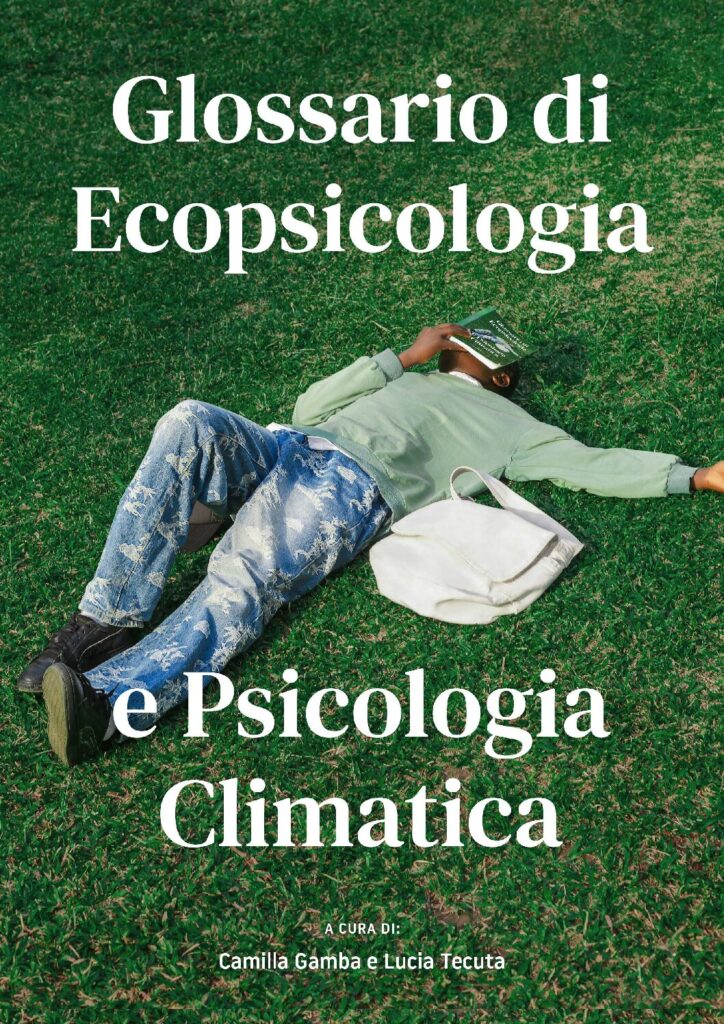
A free, downloadable glossary of ecopsychology and climate psychology: 56 key terms, from eco-anxiety and solastalgia to outdoor therapy, forest bathing and biophilia, written by a network of Italian psychologists, psychotherapists and psychiatrists. I am one of its co-authors.
Why a Glossary of Ecopsychology and Climate Psychology?
Our relationship with the natural world shapes our mental health in two directions. Time in nature can support emotional regulation, attention and a sense of belonging; at the same time, the climate and ecological crisis is becoming a source of worry, grief and distress for a growing number of people. Two fields study these questions: ecopsychology, which explores the bond between people and the more-than-human world, and climate psychology, which looks at how we respond, emotionally and collectively, to climate change.
Most of the literature on these topics is in English, and in Italy both disciplines are still little known. The authors set out to offer a shared vocabulary in Italian for clinicians, researchers, students and anyone curious about the connection between nature, environment and mental health. To our knowledge, it is one of the first glossaries of its kind in the field of psychology in Italy. Each entry gives a concise definition and suggested further reading, including Italian authors and Italian translations where available.
What’s Inside: 56 Key Terms
The entries are written in Italian. Below, each term is listed with its English equivalent, so you can find what you are looking for in either language.
Climate emotions and eco-distress
- Eco-anxiety (eco-ansia) and climate anxiety (ansia climatica): related but distinct, as the glossary explains
- Ecological grief (eco-lutto)
- Solastalgia: distress at the environmental transformation of a place that is still home
- Eco-emotions and climate emotions (eco-emozioni ed emozioni climatiche)
- Psychoterratic emotions and syndromes (emozioni e sindromi psicoterratiche)
- Denial of the climate crisis (negazione della crisi in atto), eco-awakening (eco-risveglio)
Nature-based therapies and interventions
- Outdoor therapy (terapia all’aperto), walk and talk therapy, wilderness therapy
- Forest bathing / Shinrin-yoku (bagno di foresta) and forest therapy (terapia forestale)
- Ecotherapy (ecoterapia), green mindfulness, eco-somatics (eco-somatica)
- Horticultural therapy (ortoterapia), nature prescriptions, outdoor education
- Pet therapy and animal-assisted interventions, equine-assisted therapy (ippoterapia)
- Climate Café and The Work That Reconnects (il lavoro che riconnette)
Theories, models and key concepts
- Biophilia (biofilia), Attention Restoration Theory, awe, nature deficit disorder
- Place attachment, environmental identity (identità ambientale), ecological self (sé ecologico)
- Ecological intelligence and naturalistic intelligence (intelligenza ecologica e naturalistica)
- Deep ecology (ecologia profonda), ecology of mind (ecologia della mente), affective ecology, ecocentrism, ecofeminism, ecospirituality
- Gaia hypothesis, Bronfenbrenner’s ecological systems theory, One Health and Planetary Health models
- Anthropocene, Symbiocene, hyperobject, polycrisis, speciesism and anti-speciesism
- Climate change, ecological crisis, climate adaptation and climate mitigation, pro-environmental behaviour
- The disciplines themselves: ecopsychology (ecopsicologia), environmental psychology (psicologia ambientale) and climate psychology (psicologia climatica)
My Contributions
I wrote five of the entries, drawing on my psychodynamic training and on my clinical work in natural settings, including with people affected by complex trauma:
- Biophilia (Biofilia): from E. O. Wilson’s evolutionary hypothesis to Erich Fromm’s psychoanalytic reading, and why natural environments can reduce stress, anxiety and rumination.
- Ecological intelligence (Intelligenza Ecologica): Daniel Goleman’s concept of understanding the impact of our choices on ecosystems and communities.
- Equine-assisted therapy (Ippoterapia – Terapia Assistita con il Cavallo).
- The Work That Reconnects (Il Lavoro che Riconnette): Joanna Macy’s group process for turning ecological grief and powerlessness into awareness and action.
- Pet therapy: animal-assisted interventions, read through Winnicott’s transitional object and attachment theory.
Among the contributors’ biographies, you will find me listed in both Milan and Puglia, where I work. If these themes resonate with you, you may also like my article Beyond the Therapy Room: Nature, Safety and Mental Health, on outdoor therapy and the research on green space and wellbeing.
Authors
Edited by: Camilla Gamba and Lucia Tecuta.
Contributors: Alberto Agosti, Lorenzo Bazzurro, Sophia Betrò, Maria Da Re, Antonio Danzi, Gilberto Fulvi, Barbara Montanari, Giulia Rocchi, Paola Sabatini and Nicoletta Vurro.
Copyright © 2026 Camilla Gamba, Milan, Italy. Published under the Creative Commons Attribution-NonCommercial-NoDerivatives 4.0 International licence (CC BY-NC-ND 4.0): you may download and share it for non-commercial purposes, unchanged and with attribution to the authors. Rights for text and data mining and AI training are reserved by the authors.
How to cite: Gamba, C., & Tecuta, L. (Eds.) (2026). Glossario di Ecopsicologia e Psicologia Climatica. Milan. CC BY-NC-ND 4.0.
In italiano
Scarica gratuitamente il Glossario di Ecopsicologia e Psicologia Climatica 2026, a cura di Camilla Gamba e Lucia Tecuta: 56 definizioni, con letture di approfondimento, su eco-ansia, ansia climatica, eco-lutto, solastalgia, biofilia, terapia forestale, bagno di foresta, outdoor therapy, ecoterapia, ortoterapia, pet therapy e molti altri concetti. Uno strumento pensato per psicologi, psicoterapeuti, counselor, studenti e per chiunque voglia approfondire il rapporto tra natura, ambiente e salute mentale. Scarica il glossario in PDF.
Frequently Asked Questions
What is ecopsychology?
Ecopsychology studies the psychological relationship between human beings and the natural world, and how that relationship affects wellbeing, identity and behaviour. It also informs nature-based practices such as ecotherapy and outdoor therapy.
What is climate psychology?
Climate psychology looks at how individuals and communities think, feel and act in response to climate change, including emotions such as anxiety, grief and anger, denial, and what helps people move towards adaptation and action.
Are eco-anxiety and climate anxiety the same thing?
They are often used interchangeably, but the glossary distinguishes them: climate anxiety refers specifically to worry about climate change, while eco-anxiety is broader and includes fear of the loss and degradation of the natural environment as a whole.
What is solastalgia?
Solastalgia is a term coined by the philosopher Glenn Albrecht for the distress people feel when the place they live in is damaged or transformed by environmental change. Unlike nostalgia, it does not involve moving away: home is still there, but it no longer feels the same.
Is the glossary free, and is it available in English?
Yes, it is free to download and share for non-commercial purposes under a CC BY-NC-ND 4.0 licence. It is currently available in Italian only; many of the suggested readings are in English.
Can I talk to a therapist about eco-anxiety in English?
Yes. I work with adults and young adults in English, in person in Milan and online in Puglia and across Italy. You can get in touch here.
Are you looking for an English-speaking psychotherapist and counsellor?
Specialized Psychotherapy for Expats and International Residents
Drawing on clinical training from the Tavistock and Portman NHS Foundation Trust, my practice in the Porta Romana district offers a safe space for international residents and expats seeking culturally sensitive psychological support in Milan.

I offer a safe, non-judgmental space for LGBTQIA+ clients exploring identity, relationships, and wellbeing.

Support for expats and returning Italians facing homesickness, culture shock, and the loss of belonging that living between cultures can bring.

I work with adults and young people struggling with attention, motivation, or performance-related stress, often linked to anxiety, perfectionism, or emotional avoidance.
I receive regular supervision for the work I offer and I work along the code of practice of the British Psychoanalytic Council and the Italian Association of Counselling.
Let’s Talk
Taking the first step is often the hardest, but you don’t have to do it alone. Whether you are ready to book a session or just have a few questions, feel free to reach out. I read every message personally and will get back to you within 24 hours.